The Ritual of Landing: How Discerning Travelers Are Transforming the Opening Hours of Every Journey
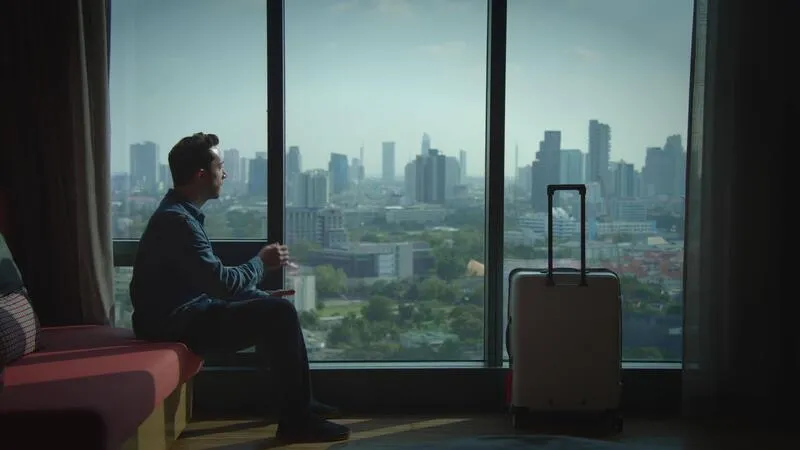
Photo: luxury traveler sitting quietly at hotel window overlooking foreign city at dawn, via static.vecteezy.com
There is a particular kind of exhaustion that arrives not with the body, but with the ambition. The traveler who has flown eleven hours from New York to Tokyo, checked into a celebrated ryokan, and immediately set out for Senso-ji before the luggage has been properly unpacked—this traveler is not experiencing Japan. They are performing it.
Something is shifting among the most thoughtful members of the traveling class. Rather than treating arrival as the starting pistol for a race through landmarks, they are reconceiving the first forty-eight hours as something far more considered: a threshold ritual, a period of deliberate recalibration that determines the quality of every day that follows.
The Cost of the Immediate Rush
American travel culture has long celebrated productivity, even in leisure. The impulse to maximize every hour—to return home with a filled itinerary and a camera roll to match—is deeply embedded in how many of us approach time away. Yet this orientation, however understandable, extracts a quiet cost.
When we arrive in a new place and immediately impose our expectations upon it, we rarely encounter the destination as it actually is. We encounter instead the version of it we have already assembled in our imaginations: the curated photographs, the reviewed restaurants, the ranked attractions. The place becomes a backdrop rather than a presence.
Sophisticated travelers are recognizing this dynamic and choosing to disrupt it. The first forty-eight hours, they have discovered, are not hours to be spent—they are hours to be invested.
Arrival as Orientation, Not Itinerary
What does a deliberate arrival look like in practice? It begins, perhaps counterintuitively, with restraint.
Consider the traveler who arrives in Marrakech after an overnight flight from the East Coast. Rather than heading immediately to the medina, they allow themselves a morning of stillness at the riad—taking breakfast on the terrace, listening to the city's sounds from a distance, permitting the light and the air and the particular quality of morning noise to register without interpretation.
This is not passivity. It is attunement. The traveler is gathering information through the senses before the intellect has had time to categorize and file it away. They are, in the truest sense, arriving.
The afternoon might bring a single, unhurried walk—not to a specific destination, but through the immediate neighborhood. No map, no agenda. Only observation. What do people carry? How do they greet one another? Where do they pause? These are the questions that unlock a place far more reliably than any guidebook.
The First Meal as Intelligence Gathering
Among intentional travelers, the first meal in a new destination carries unusual significance. It is chosen not for prestige or novelty, but for proximity and authenticity. A neighborhood café rather than a celebrated restaurant. A market stall rather than a Michelin-starred dining room.
This choice is strategic. The celebrated restaurant will still be there on the fourth night, when the traveler has earned the context to appreciate it fully. The neighborhood café, however, offers something irreplaceable: an unmediated encounter with how ordinary life tastes in this particular corner of the world.
Conversations begun over simple meals have a different quality than those initiated in formal settings. A question about the local bread, asked with genuine curiosity, can open doors that a concierge recommendation rarely does. The most meaningful local connections—with a pastry vendor in Lyon, a tea house proprietor in Kyoto, a fishing family in the Azores—frequently begin in these unassuming first encounters.
Managing the Body to Free the Mind
No philosophy of arrival can ignore the physiological reality of long-haul travel. Jet lag is not merely inconvenient; it actively distorts perception, flattens emotional responsiveness, and undermines the very qualities—presence, curiosity, openness—that define meaningful travel.
The most experienced long-distance travelers have developed personal protocols for managing this transition. Some swear by immediate exposure to natural light upon arrival, regardless of fatigue. Others maintain a strict discipline around mealtimes, anchoring themselves to the local schedule from the first hours. A number practice a brief period of outdoor physical movement—a walk, a swim—as a way of signaling to the body that the transition is complete.
What unites these approaches is the understanding that managing the body in the first forty-eight hours is not a concession to weakness. It is an act of respect—for the destination, for the journey, and for the quality of experience one hopes to have.
Setting the Tone for Everything That Follows
Perhaps the most compelling argument for a deliberate arrival is the effect it has on the days that follow. Travelers who have taken the time to orient themselves—physically, emotionally, sensory—consistently report that their subsequent experiences feel richer and more connected.
This is not coincidence. When we have allowed a place to introduce itself on its own terms, we carry a different quality of attention through the rest of the journey. We notice more. We are surprised more readily. We are less likely to impose our preconceptions and more likely to encounter the unexpected with genuine curiosity.
The first forty-eight hours, approached with intention, become a kind of tuning—an adjustment of the traveler's instrument to the frequency of the place. Everything played afterward resonates more fully because of it.
An Invitation to Arrive, Truly
Wanderluce has long held that the most luminous travel experiences are not found in the checking of boxes, but in the quality of attention brought to each moment of a journey. The ritual of arrival is where that quality of attention is either established or squandered.
The traveler who resists the impulse to rush—who gives themselves permission to be disoriented, to be quiet, to be curious before they are certain—is not wasting time. They are making an investment whose returns compound across every hour that follows.
To arrive well is, in the end, the first and most essential art of travel.