The Cartography of Connection: How the Most Fulfilled Travelers Map Their Lives Through the People They've Met
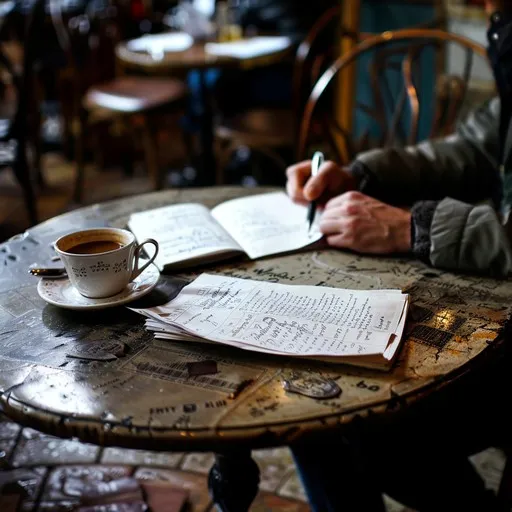
Photo: traveler writing handwritten letter at cafe table with world map and coffee in warm light, via images.stockcake.com
Somewhere in a study in San Francisco, a woman in her sixties maintains a correspondence with a ceramicist she met in Oaxaca seventeen years ago. They exchange letters—actual letters, written by hand on good paper—twice a year. The ceramicist's daughter, who was three when they first met, is now in university. The woman in San Francisco attended the opening of the ceramicist's first gallery show, having flown specifically for the occasion. When asked about her most memorable travel experiences, she does not mention the pyramids at Teotihuacán or the mezcal tastings in the Sierra Juárez. She mentions Esperanza.
This is the kind of travel that does not photograph well and rarely appears in curated destination guides. It is also, by any serious reckoning, the most valuable kind.
The Poverty of the Destination Mindset
The dominant vocabulary of travel content—bucket lists, must-sees, top-ten rankings—implicitly frames the world as a collection of sites to be visited and checked off. In this framing, people encountered along the way are incidental: pleasant additions to the scenery, perhaps, but not the point.
The travelers who have been moving through the world for decades, with genuine attention and open hearts, tend to arrive at a different conclusion. For them, the places are the scaffolding. The relationships are the structure.
This is not a romantic sentiment. It is a practical observation about what persists. The memory of a spectacular view fades with time, or is overwritten by the next spectacular view. The memory of a conversation that changed how you understood something—about food, or faith, or the nature of family—does not fade. It compounds.
The Art of the First Encounter
Meaningful travel relationships rarely begin with intention. They begin with attention.
The traveler who is genuinely curious—who asks questions and listens to the answers, who is willing to be changed by what they hear—creates the conditions in which real connection becomes possible. This is a quality that cannot be manufactured, but it can be cultivated. It requires, above all, the willingness to be interested in a person's life rather than merely their usefulness to your itinerary.
A sommelier in Burgundy who senses that a guest is asking about her grandmother's vineyard out of genuine interest rather than social performance will respond differently than she would to the same question posed as small talk. A boat captain in the Florida Keys who observes a traveler watching the pelicans with real attention will offer a different kind of conversation than he would to someone looking at their phone.
The most enduring connections tend to begin in these moments of mutual recognition—when two people, from vastly different contexts, discover a shared frequency.
Maintaining the Thread
The encounter is the beginning. What follows—the maintenance of the relationship across years and distance—is where most travelers fall short, not from indifference but from the structural pressures of contemporary American life.
The correspondences that endure tend to share certain qualities. They are consistent without being obligatory. They acknowledge the passage of time and the changes it brings. They are genuinely reciprocal—the traveler is as willing to share their own life as they are to inquire about another's.
The medium matters less than the sincerity. Some of the most durable travel friendships are sustained through handwritten letters; others through brief, irregular messages that nonetheless carry real warmth. What matters is that the connection is tended—that both parties understand it to be a living thing that requires occasional nourishment.
Return visits, when they occur, carry a particular quality of meaning. To arrive in a place where someone is genuinely glad to see you—not as a tourist to be served, but as a friend to be welcomed—is to experience a destination in a register that no amount of luxury accommodation can replicate. The city looks different when someone who loves it is walking beside you.
The Epistolary Tradition in a Digital Age
There is something to be said for the deliberate anachronism of the handwritten letter as a tool of travel correspondence. In a culture saturated with instant communication, the choice to write by hand—to select the paper, compose the thoughts, address the envelope—is a signal. It says: this relationship merits my slowest attention.
A number of discerning travelers have rediscovered the pleasure of maintaining what might be called a travel correspondence practice: a small portfolio of relationships, distributed across the globe, sustained through periodic written exchange. Some keep dedicated stationery for this purpose, chosen to reflect the aesthetic of their own lives. Others collect paper and cards from each country they visit, using them later in letters to contacts made elsewhere.
This practice is not nostalgia. It is a recognition that the medium of communication shapes the quality of connection it carries. The email dashed off between meetings and the letter composed on a Sunday morning are not the same gesture, even if their content is similar.
Measuring a Traveling Life
There is a question worth sitting with, for any traveler of serious intent: how do you measure the success of a life spent in motion?
The conventional answers—countries visited, miles accumulated, properties stayed in—have the virtue of quantifiability, but they measure the wrong things. They capture the surface of a traveling life without touching its depth.
The more illuminating measure, for those who have been traveling long enough to reflect on it honestly, tends to be relational. How many people in the world know your name and are glad of it? In how many cities would someone set an extra place at the table if you appeared at the door? Across how many time zones do your friendships extend?
This is the cartography that matters: not the map of places visited, but the map of connections made and maintained—the invisible web of human relationship that a life of intentional travel, conducted with genuine curiosity and care, quietly accumulates.
An Ongoing Invitation
At Wanderluce, we understand that the most luminous journeys are not merely geographic. They are human. The destinations we illuminate are not only places on a map but people who inhabit them—and the extraordinary possibility, available to any traveler willing to be truly present, of carrying a piece of their world home.
The ceramicist in Oaxaca. The sommelier in Burgundy. The boat captain in the Keys. They are waiting, as they always have been, for the traveler who arrives with genuine attention. The only question is whether you will be that traveler—and whether, when the journey ends, you will find a way to keep the conversation going.