Settling In: How the World's Most Discerning Travelers Are Trading Whirlwind Tours for Immersive Long-Stay Residencies
There is a particular kind of exhaustion that follows the classic grand tour — the blur of hotel lobbies, the relentless choreography of check-ins and departures, the nagging sense that you have seen everything and experienced nothing. For a generation of American travelers who have already circled the globe multiple times, that fatigue has become the catalyst for a profound reconsideration of what luxury travel actually means.
The answer, increasingly, is stillness.
Across Europe's sun-drenched hilltop villages, the temple-lined waterways of Southeast Asia, and the volcanic coastlines of the Pacific, a movement is quietly gathering momentum. Call it slow luxury, the long stay, or the residential approach — whatever the nomenclature, the principle is identical: immerse yourself completely, linger deliberately, and allow a place to reveal itself on its own terms rather than yours.
The Shift Away from the Highlight Reel
For decades, the aspirational travel itinerary was defined by accumulation. Rome on Tuesday, Florence on Thursday, the Amalfi Coast for the weekend. Social media amplified this tendency, rewarding the breadth of a traveler's geographic portfolio over the quality of any single encounter. The result was a particular brand of opulence — five-star hotels, Michelin-starred dinners, private transfers — that was undeniably comfortable yet curiously hollow.
"Our most sophisticated clients have reached a point where they no longer need to prove they've been somewhere," says Margaux Delacroix, a luxury travel concierge based in New York who specializes in curated European residencies. "They want to feel something genuine. They want to know the baker by name, to have a favorite table at a neighborhood trattoria that doesn't appear in any guidebook. That kind of intimacy simply cannot be purchased on a seven-day itinerary."
This sentiment is echoed by travel designers across the industry. The pivot toward extended stays is not merely a lifestyle preference — it reflects a maturing definition of what premium travel can deliver.
What an Extended Residency Actually Looks Like
The mechanics of the long stay vary considerably depending on destination, duration, and personal preference, but several models have emerged as particularly compelling for the American luxury traveler.
In Tuscany and Provence, private villa programs allow guests to occupy fully staffed historic estates for periods ranging from three weeks to three months. These are not rental properties in the conventional sense. Organizations such as Tuscany Now & More and CV Villas curate collections of aristocratic properties — former monasteries, Renaissance farmhouses, noble family estates — that come complete with dedicated housekeepers, private chefs who source ingredients from the estate's own gardens, and concierge teams embedded within the local community. The experience is less "vacation rental" and considerably closer to inhabiting a second home with an extraordinarily capable staff.
In Japan, a small number of ultra-private ryokan have begun offering extended residency programs in which guests occupy private wings of historic inns for multi-week periods. The arrangement grants access to rituals — seasonal tea ceremonies, private ikebana instruction, early-morning visits to local markets before the tourist crowds arrive — that are simply unavailable to the transient visitor.
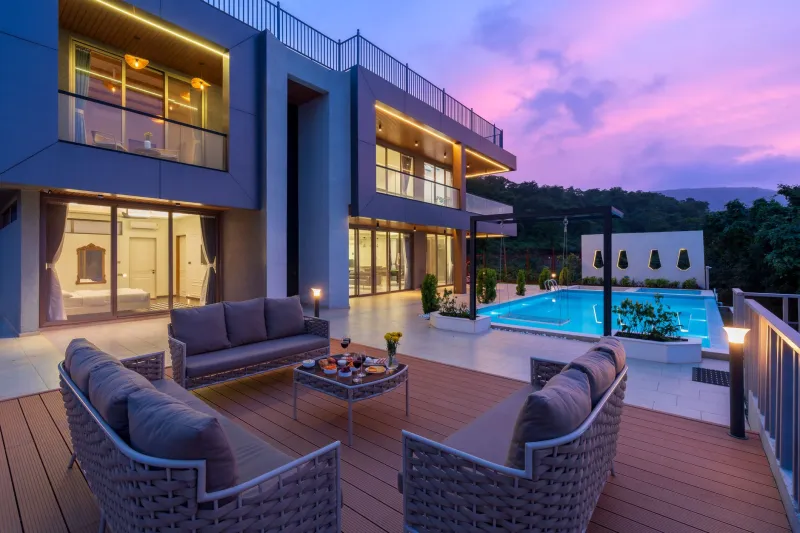
Meanwhile, in destinations such as Bali, the Algarve, and the Greek islands, a new category of luxury long-stay property has emerged to meet demand explicitly. These are not hotels retrofitted for longer occupancy, but architecturally significant private residences designed from the outset to support extended inhabitation: fully equipped professional kitchens, dedicated workspace, curated libraries, and gardens intended for genuine use rather than aesthetic display.
The Hidden Architecture of Authentic Connection
What separates the extended residency from a prolonged hotel stay is not, ultimately, the physical property. It is time — and what time permits.
Within the first week of a long stay, the rhythms of a place begin to assert themselves. The morning light at a particular hour. The sound of the weekly market assembling three streets away. The gradual recognition, on the part of local shopkeepers and restaurateurs, that this visitor is not passing through. These small accumulations of familiarity constitute something that no amount of premium service can manufacture: the sensation of belonging, however temporarily, to a place.
"By the third week, my clients stop asking me for restaurant recommendations," Delacroix notes with evident satisfaction. "They've developed their own. They're having neighbors over for dinner. They've found a hiking trail that none of the guidebooks mention. That's when I know the residency has worked."
For families with school-age children, the educational dimension adds another layer of richness. Several elite long-stay programs now partner with local schools, language academies, and cultural institutions to provide structured immersion experiences for younger guests — transforming what might otherwise be a parental indulgence into a genuinely formative experience for the entire household.
The Financial Architecture of the Long Stay
It would be disingenuous to discuss extended residencies without acknowledging their considerable cost. A fully staffed Tuscan estate for a month can command anywhere from $40,000 to well over $150,000 depending on the property, season, and level of service. A private villa in Bali with dedicated staff runs substantially less — often between $8,000 and $25,000 per month — though the experience is no less curated.
Set against the cumulative expense of a conventional luxury itinerary — business-class flights between multiple destinations, premium hotel rates across six or eight properties, private transfers, and the inevitable cost of rushed, tourist-facing dining — the economics of the long stay become considerably more defensible. Many travelers discover, to their surprise, that spending more time in fewer places is not only more enriching but frequently more cost-effective than the alternative.
There is also an emerging category of membership-based residency programs designed to bridge the gap between ownership and occasional rental. Organizations such as Inspirato and Rocco Forte's private residences offer subscribers access to curated portfolios of luxury properties with the consistency of standards that frequent luxury travelers have come to require.
The Illumination That Only Time Provides
At Wanderluce, we have always believed that the most meaningful journeys are those that change the traveler in some measurable way — that leave behind not merely photographs and receipts, but a genuinely expanded understanding of the world and one's place within it. By that measure, the extended residency may be the most potent travel format available to the discerning American wanderer today.
To spend a month in a single extraordinary place is to accept an invitation that the quick trip perpetually declines: the invitation to be present, to be known, and to know. The hidden trattoria, the local festival that no tour operator advertises, the afternoon conversation with a neighbor that reshapes how you understand an entire culture — these are the illuminations that only time can deliver.
The world's most remarkable destinations have always rewarded patience. The art of slow luxury lies in finally having the wisdom — and the will — to offer it.