The Woman at the Cannon: Molly Pitcher's Enduring Legacy and What It Means for the Historically Minded Traveler
Few figures from the American Revolution have captured the national imagination quite like Molly Pitcher, the legendary woman who stepped into the heat of battle and changed the course of history. Her story is not merely a footnote in military chronicles — it is a testament to the power of individual courage to alter collective destiny. For the discerning traveler drawn to the living landscapes of American history, understanding her impact transforms a journey through the Northeast into something far more profound.
Who Was Molly Pitcher?
The name "Molly Pitcher" is widely believed to be a composite figure, one whose legend grew from the real actions of Mary Ludwig Hays — and possibly other women — during the Battle of Monmouth on June 28, 1778. On that sweltering New Jersey summer day, temperatures reportedly reached over 100 degrees Fahrenheit. Women accompanying the Continental Army, often referred to as "camp followers," performed essential roles: laundering, cooking, nursing, and, crucially, carrying water to soldiers on the front lines. It is from this act — carrying pitchers of water to exhausted, heat-stricken men — that the enduring name was born.
Mary Hays, wife of artilleryman William Hays, was among these women. When her husband collapsed at his cannon — whether from heat, exhaustion, or a wound remains a matter of historical debate — accounts suggest she took his place at the artillery piece, loading and firing with the discipline of a trained soldier. Her presence on the battlefield, in the full view of officers and enlisted men alike, was both extraordinary and galvanizing.
The Military Impact of Her Actions
To appreciate Molly Pitcher's impact on the Revolutionary War, one must understand the critical importance of the Battle of Monmouth itself. The engagement came at a pivotal moment: General George Washington's Continental Army had just endured the brutal winter at Valley Forge and was, in many respects, newly forged into a more disciplined fighting force under the tutelage of Baron Friedrich von Steuben.
The battle ended in a tactical stalemate, but it demonstrated that the Continental Army could stand toe-to-toe with the British regulars — a symbolic and psychological victory of considerable weight. The maintenance of artillery positions was central to that stand. Every cannon kept operational, every artilleryman replaced in the heat of combat, contributed directly to the army's ability to hold the line.
In this context, Mary Hays's actions were not merely symbolic. By keeping a cannon in operation at a critical moment, she contributed — however modestly in the grand tactical calculus — to the army's sustained firepower. More significantly, her example bolstered morale among soldiers who witnessed it. General Washington himself is reputed to have acknowledged her bravery, though the precise nature of any commendation remains disputed by historians.
The Broader Impact: Women in the Revolutionary War
Molly Pitcher's legacy extends far beyond a single afternoon on a New Jersey battlefield. Her story became a vessel for a larger, often overlooked truth: that women were indispensable to the American war effort. Camp followers, nurses, spies, and fundraisers all played roles that the formal military record has historically undervalued.
Figures such as Deborah Sampson, who disguised herself as a man and served as a soldier, and Phillis Wheatley, whose poetry galvanized patriotic sentiment, remind us that the Revolution was not won by men alone. Molly Pitcher became the most accessible symbol of this collective female contribution — a figure simple enough to be taught to schoolchildren, yet complex enough to reward serious historical inquiry.
Her story also opened a sustained national conversation about women's roles in warfare and civic life, a conversation that would echo through the Civil War, both World Wars, and into the modern era of fully integrated armed forces.
Where to Experience Her Story as a Luxury Traveler
For those who travel with intellectual curiosity as their compass, the landscapes associated with Molly Pitcher offer a remarkably rich itinerary.
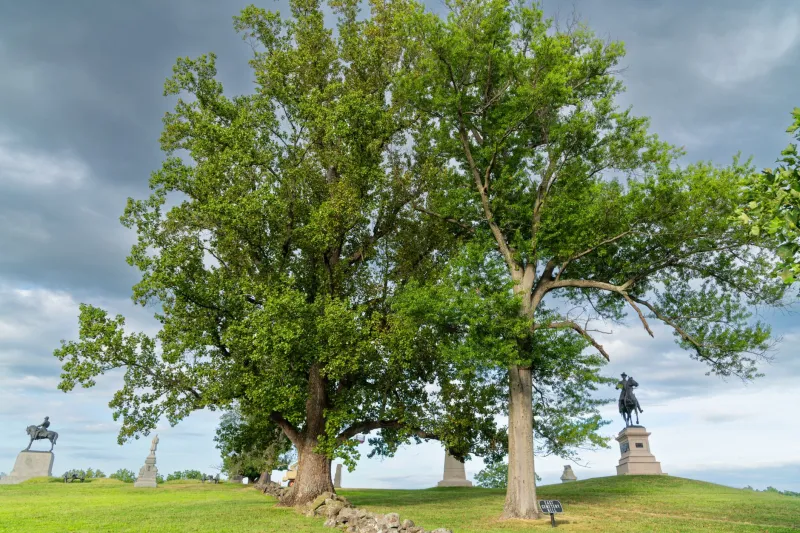
Monmouth Battlefield State Park, New Jersey stands as the most direct portal into her world. Spanning over 1,800 acres of preserved farmland and rolling terrain, the park maintains the battlefield in a state that allows visitors to genuinely feel the geography of the engagement. The visitor center offers well-curated exhibits, and the landscape itself — particularly in the golden light of a late summer morning — possesses a quiet grandeur that rewards unhurried contemplation.
Carlisle, Pennsylvania, where Mary Ludwig Hays lived much of her life and is buried, offers another layer of the story. The Old Graveyard on East South Street contains her monument, and the surrounding Cumberland Valley is among the more quietly beautiful regions of the mid-Atlantic, well-suited to a thoughtful driving itinerary that might also include the historic town of Gettysburg to the south.
Those who prefer the refined comforts of a curated stay will find that the greater Philadelphia region — within easy reach of both sites — offers a number of distinguished boutique hotels and historic inns that provide an appropriately atmospheric base for this kind of historically immersive travel.
The Philosophy of Encountering History on the Road
There is a particular quality of attention that historical travel demands — one that luxury travel, at its finest, is uniquely positioned to cultivate. When one arrives at a battlefield not as a hurried tourist but as a genuine inquirer, having read the primary sources, understood the strategic context, and allowed oneself the time to simply stand and observe, the experience transcends sightseeing entirely.
Molly Pitcher's story, in this sense, is an invitation. It asks the traveler to consider how individual acts of courage, performed in obscurity and without guarantee of recognition, can nonetheless alter the arc of history. It is a question worth carrying with you — through the green fields of Monmouth, through the quiet streets of Carlisle, and well beyond.
The most luminous journeys are not always those that take us furthest from home. Sometimes, they are the ones that return us, with fresh eyes, to the ground beneath our own feet.