Perth Through Time: How Australia's Golden City Has Grown Into One of the World's Most Compelling Luxury Destinations
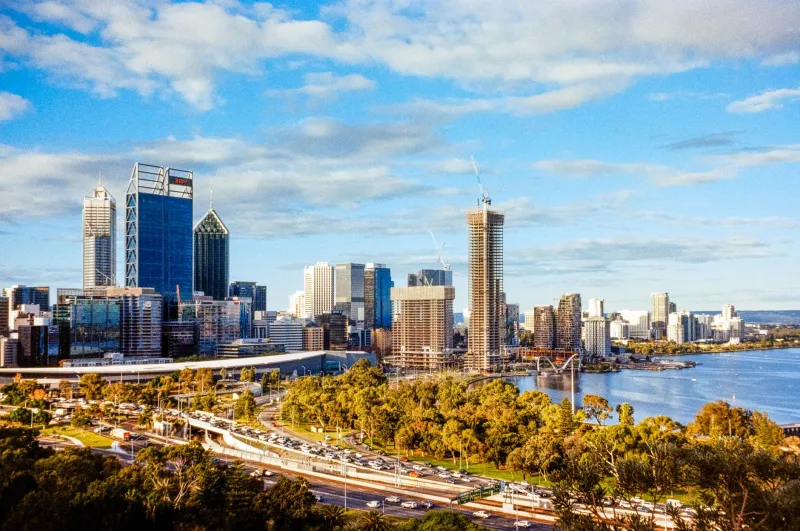
To understand Perth as it exists today — gleaming, prosperous, and possessed of a quiet confidence that sets it apart from Australia's more celebrated eastern cities — one must first understand where it began. The story of Perth's population is, in many ways, the story of a city that grew not gradually but in dramatic, history-shaping surges, each one driven by the particular alchemy of geography, resource, and human ambition.
Perth in 1901: A City on the Cusp of Transformation
When Australia federated on January 1, 1901, becoming a Commonwealth of self-governing colonies united under a single national framework, Perth was the capital of Western Australia and home to approximately 61,000 people. This figure, drawn from the colonial census records of the era, places Perth as a modest but rapidly expanding settlement — one that had only recently experienced the convulsive growth brought on by the Western Australian gold rush of the 1890s.
The Kalgoorlie gold rush, which began in earnest in 1893, transformed Perth from a sleepy administrative center of fewer than 10,000 residents into a boomtown almost overnight. Prospectors, merchants, engineers, and opportunists flooded into Western Australia from the eastern colonies, from Britain, and from as far afield as the United States and China. By the time Federation arrived, Perth had more than quintupled its population in less than a decade — a rate of growth that was, by any historical measure, extraordinary.
The city's architecture from this period still stands in elegant testament to that era of sudden wealth. The grand Victorian and Edwardian buildings along St. George's Terrace, the ornate facades of Fremantle's port district, and the formal gardens of Kings Park all bear the imprint of a community that had money to spend and ambitions to match.
The Century of Growth: From Federation to Modernity
From its 1901 baseline of approximately 61,000 residents, Perth's population has grown to more than 2.1 million as of the most recent estimates — a thirty-four-fold increase over the course of a single century. This growth has not been linear. Perth expanded steadily through the early twentieth century, absorbed waves of post-World War II immigration that brought communities from across Europe and Southeast Asia, and then surged again during the mineral and energy booms of the 1960s, 1980s, and 2000s.
The city's location — perched on the Indian Ocean coast, closer to Singapore than to Sydney — has always defined its character. Perth is, in the most literal geographic sense, one of the world's most isolated major cities. And yet this isolation has never diminished it. If anything, it has sharpened Perth's sense of self, producing a culture that is confident, outward-looking, and deeply attuned to the extraordinary natural environment that surrounds it.
Why Perth Is Capturing the Attention of Luxury Travelers
For the affluent American traveler accustomed to the well-worn circuits of European capitals and Southeast Asian resort islands, Perth represents something genuinely rare: a world-class destination that has not yet been overrun. Its beaches — Cottesloe, Scarborough, City Beach — are among the finest on the planet, stretching for miles along a coastline where the Indian Ocean arrives in long, luminous swells. Its restaurant scene, anchored by an extraordinary bounty of local seafood, Margaret River wines, and produce from the fertile southwest, rivals anything available in Sydney or Melbourne.
The luxury accommodation landscape in Perth has matured considerably in recent years. Properties such as the COMO The Treasury, housed within a magnificently restored nineteenth-century State Buildings complex in the heart of the city, offer the kind of seamless integration of heritage architecture and contemporary refinement that discerning travelers have come to expect from the world's finest hotels. The newly opened Crown Towers Perth, part of the sprawling Crown complex on the banks of the Swan River, brings Las Vegas-scale glamour to the Indian Ocean edge.
The Surrounds: A Luxury Traveler's Itinerary Beyond the City
No visit to Perth is complete without an excursion into the broader Western Australian landscape — a terrain of such scale and drama that it renders even the most seasoned traveler genuinely humble. The Margaret River wine region, approximately three hours south of the city, produces Cabernet Sauvignon and Chardonnay of international standing, and its small luxury lodges and cellar-door restaurants offer experiences of rare intimacy and quality.
Further afield, the Kimberley region in Western Australia's far north is one of the last truly wild places on earth — a landscape of red gorges, ancient rock art, and vast tidal flats accessible primarily by private charter flight or luxury expedition vessel. For the traveler who has seen much of the world and is searching for something genuinely uncharted, the Kimberley delivers with an authority that few destinations can match.
A City That Earns Its Place on the Luxury Map
Perth's journey from a colonial outpost of 61,000 in 1901 to a sophisticated metropolis of more than two million is not merely a demographic story. It is a narrative of ambition, reinvention, and the particular kind of confidence that comes from building something extraordinary in a place where the rest of the world was not watching.
American travelers who make the journey — and it is a long one, best undertaken in the flat-bed comfort of a business-class cabin — invariably find a city that exceeds every expectation. Perth does not announce itself. It simply reveals itself, slowly and generously, to those who take the time to arrive.